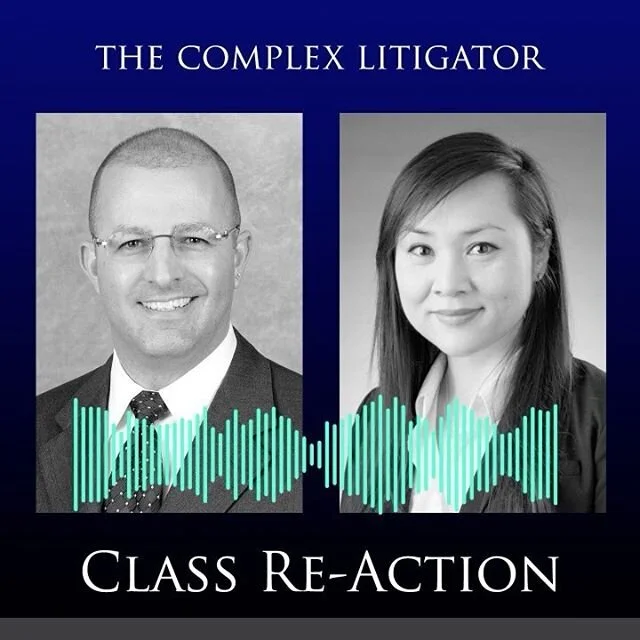
Mazza, et al. v. American Honda Motor Company was argued before the Ninth Circuit today

In the matter of Mazza, et al. v. American Honda Motor Company, the Ninth Circuit heard oral argument today.  Defendant's Rule 23 Petition was granted after the District Court certified UCL and CLRA claims on a nationwide basis.  The District Court's choice-of-law analysis was the primary focus.  If reports are accurate, The Ninth Circuit may very well send the matter back to the trial court for some adjustment to the choice of law analysis and further consideration of whether any other state's interests outweigh California's strong interests in regulating the conduct of its corporate citizens and ensuring that they deal appropriately with all consumers, wherever situated.  Or the Court might decide that, in this particular case, the comparison of interests was not shown to require the application of other laws.  You can listen and decide for yourself here.

California Supreme Court activity for the week of June 7, 2010

After two weeks with no conferences, the California Supreme Court held its (usually) weekly conference today.  The only marginally notable result I see is:

  • A non-substantive correction to the opinion in Martinez v. Combs (June 9, 2010) (expansive definition of "employee" for certain labor code violations) was issued.  The decision was mentioned on this blog here.

RSS feeds on The Complex Litigator

If you subscribe to the RSS feed provided by Feedburner (now Google Feedburner, actually), something seems to have gone wrong with it in the last week.  I suggest changing over to the RSS feed provided by SquareSpace:  http://www.thecomplexlitigator.com/post-data/rss.xml

I may need to abandon the FeedBurner feed if it doesn't correct itself soon, but I didn't want to cut off subscribers without warning about the possibility of this change.

American Nurses Association v. O'Connell invalidates as illegal a portion of a class action settlement involving rights of students with diabetes

Class actions involving allegations of discrimination regularly include injunctive relief provisions as part of a settlement or judgment.  However, the complexity of these types of actions increases the likelihood that settlement terms will have unintended consequences.  In American Nurses Association v. O'Connell (June 8, 2010), the Court of Appeal (Third Appellate District) reviewed a challenge to terms of a class action settlement between public school students and Jack O'Connell, in his capacity as the Superintendent of Public Schools for California, the Board of Education of California and the individual members of the Board of Education, the California Department of Education (CDE), and two local school districts and their superintendents.  The students alleged defendants violated various federal laws (ADA and others) by failing to ensure the provision of health care services to students with diabetes, including insulin administration, that was necessary to enable those students to obtain free appropriate public education.  The settlement of that action required, among other things, the issuance of an advisory by the CDE about insulin administration.  The advisory took the position that "in order to comply with federal law, California law should be interpreted to allow, if a licensed person is not available or feasible, trained unlicensed school employees to administer insulin during the school day to a student whose Section 504 Plan or IEP requires such insulin administration."  (Slip op., at 3.)

The American Nurses Association and the American Nurses Association/California filed an action against O'Connell as Superintendent of Public Instruction and the CDE challenging section 8 of the advisory, the portion of the legal advisory that permits unlicensed school employees to administer insulin to students with diabetes.  The Nurses Associations alleged that section 8 is inconsistent with the Nursing Practice Act (NPA) (Bus. & Prof. Code, § 2700 et seq.) and is an illegal regulation implemented by the CDE without compliance with the Administrative Procedure Act (APA) (Gov. Code, § 11340 et seq.).

The trial court agreed with the Nurses Associations, ruling that the NPA prohibited the administration of insulin by unlicensed school employees.  The trial court also rejected the argument that California's laws were preempted by federal law.  Finally, the trial court determined that the challenged portion of the legal advisory was an invalid regulation under the APA.  The Court of Appeal affirmed the finding that current California law does not permit the administration of insulin by unlicensed school employees.  Having so ruled, the Court of Appeal did not reach the alternative basis for the trial court's ruling.

The only moral of the story is that you must craft your injunctive relief language with great care.

How-to: Fix PDF files that are rejected by the Central District filing system because of links - The Simple Method

I recently provided a method for dealing with PDFs rejected by the CM/ECF filing system (as it is implemented by the U.S. District Court for the Central District of California).  That method is detailed here.  While that process of exporting a problematic document out to a new document format (XPS) and then back into PDF deals with a number of problems, not everyone will find it to be a comfortable solution.

Here is an alternative method for removing links from a PDF, if you have Acrobat 9:

  1. From the Advanced menu, select "Document Processing"
  2. Choose the "Remove All Links..." option
  3. Do it
That does it.  External hyperlinks distress the CM/ECF system, which, presumably, has been set to search for such links in order to prevent exploits that would lure unsuspecting clerks and judges to malicious websites.

Brinker Watch 2010 - Version 2

In March of this year, I observed that Brinker Restaurant v. Superior Court (Hohnbaum) was fully briefed back in October 2009.  At that time, I moved the over-under on an Opinion release date from August 2010 to October 2010.  I regret to inform anyone with office pools that I must now make a second, larger move of the line and set the over-under at February 2011.

The problem arises because the Supreme Court is done hearing cases for Summer 2010.  As you can see here, July and August will have no case arguments.  September is the earliest that Brinker could be placed on an oral argument calendar.  For purposes of wagering only (which I fully support but will not participate in), I'm guessing that the argument occurs in November, resulting in a February 2011 opinion release target date.

Martinez v. Combs receives thorough treatment from The California Wage and Hour Law Blog

The California Supreme Court, in Martinez v. Combs (May 20, 2010) (reposted to correct formatting error), addressed a topic that should prove to be of long-lasting significance.  The opinion addresses the weighty question of who is and is not an "employee" under California wage law.

The California Wage Wage and Hour Law Blog, authored by Steven G. Pearl, includes a thorough post discussing this holding, including this important observation:

[T]he Wage Orders set forth a multi-pronged, disjunctive definition of employment: an employer is one who, directly or indirectly, or through an agent or any other person, engages, suffers, or permits any person to work, or exercises control over the wages, hours, or working conditions of any person. Slip op. at 25-26. The “engage, suffer, or permit” component of the definition does not require a common law “master and servant” relationship, but is broad enough to cover “irregular working arrangements the proprietor of a business might otherwise disavow with impunity.” Slip op. at 25. Further, “phrased as it is in the alternative (i.e., wages, hours, or working conditions”), the language of the IWC's 'employer' definition has the obvious utility of reaching situations in which multiple entities control different aspects of the employment relationship, as when one entity, which hires and pays workers, places them with other entities that supervise the work.” Slip op. at 26-27. Finally, the IWC’s “employer” definition is intended to distinguish state law from the federal FLSA.

This is a monumental clarification of the breadth of the definition of employment when wage laws are at issue.  The opinion also provides a mighty boost to the authority of the IWC.

For more, visit the blog or see today's Daily Journal for a revised version of the same article.

Refusing to produce documents? Not priceless.

The correct answer, at least for yesterday, is $25,000. I normally don't write, even obliquely, about cases that I am actively litigating, but I felt like I should bend the rule this one time. A trial court granted $25,000 in monetary sanctions for a defendant's failure to comply with a discovery order. I'm trying to be a "glass is a little over half full" kind of guy. I asked for $45,000.

Court of Appeal reverses trial court and directs certification of a negligence class action

Now don't go all wobbly.  Sure, in a negligence case, the trial court denied plaintiffs' motion to certify a class, finding that no community of interest existed and that the class action vehicle was not a superior method of resolving the claims of putative class members.  But that doesn't mean that California is suddenly a hotbed of negligence class actions.  Negligence claims are still notoriously difficult to certify.  Despite all that, this decision is worth a read.

In Bomersheim v. Los Angeles Gay And Lesbian Center (May 26, 2010), the Court of Appeal (Second Appellate District, Division One) reviewed a trial court order denying class certification.  Concluding that the order was based on improper criteria and was not supported by substantial evidence, the Court reversed and directed the trial court to grant the motion.

Read More

Video available from Federalist Society program on Business & Professions Code section 17200

On May 19, 2010, I participated in a panel discussion presented by the Federalist Society.  The theme of the panel discussion was "California's 17200 -- Its Use and Abuse."  The panelists were:

  • Jeremy B. Rosen, partner, Horvitz & Levy
  • William L. Stern, partner, Morrison Foerster
  • Shaun Martin, Shaun Martin, Professor, University of San Diego School of Law, and,
  • me

The Hon Michael Orfield (Ret.), served as the panel moderator.

Video of the panel discussion is now available on youtube here.

It was an entertaining discussion.  There was some irony in the fact that the defense-oriented panelists argued for more government enforcement and the plaintiff-oriented panelists argued for less government enforcement and more private-sector regulatory enforcement.  Fun times.